THE LAST TRUMP
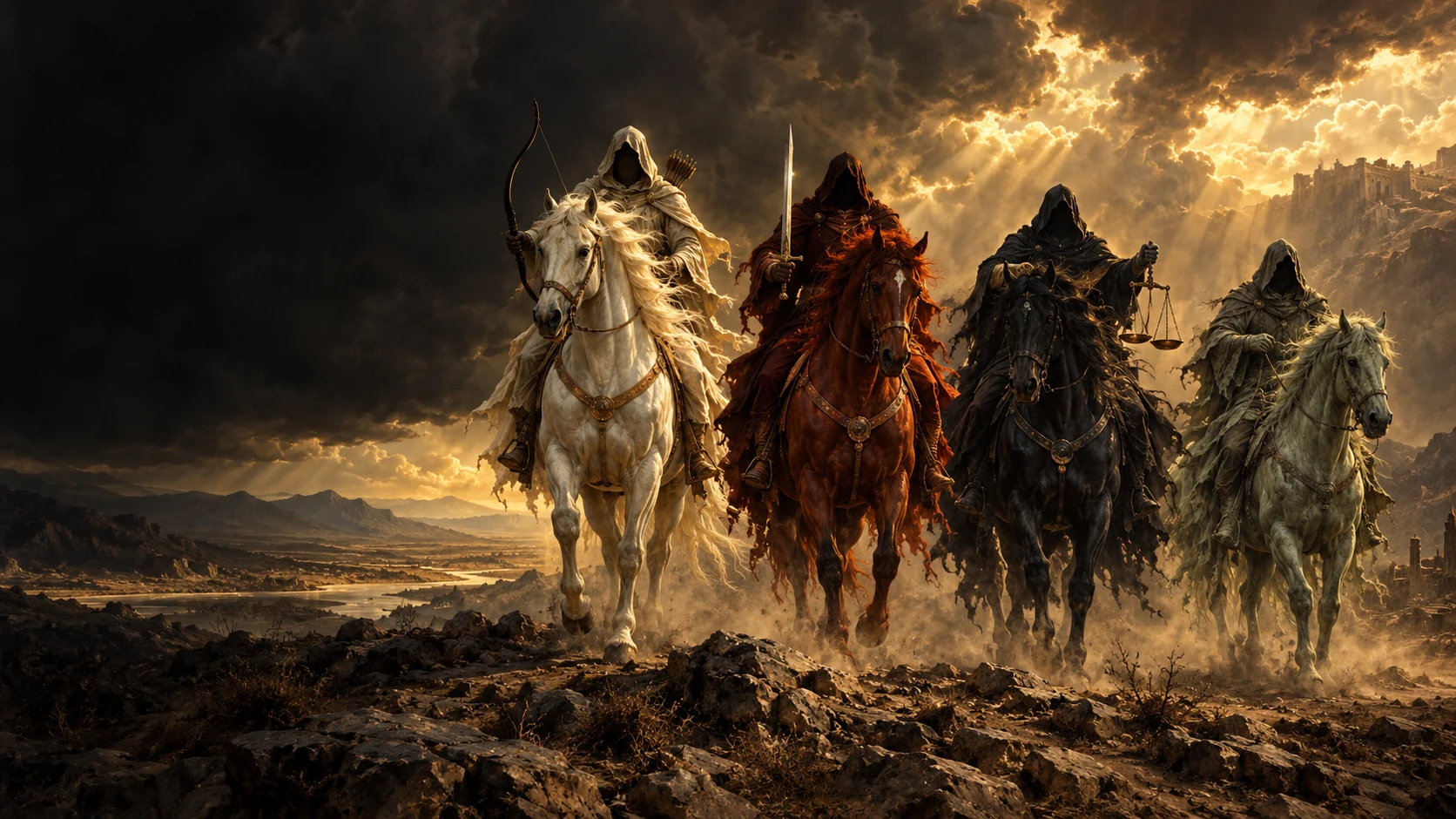
Symbolic illustration of four riders on white, red, black and pale horses beneath a stormlit sky
A Scripture-first exploration · Revelation 6

The Four
Horsemen.

Four riders. Four opened seals.
A vision we can examine carefully—even where its timing remains uncertain.

Open the Scriptures
“Prove all things; hold fast that which is good.”1 Thessalonians 5:21 · KJV

There is no shame
in an honest question.

Revelation tells us what John saw as the Lamb opened the seals. It does not supply every date, interval, or endpoint we might want for a chart. Careful study begins by distinguishing what is written from what we infer. We can take the vision seriously without pretending every question has been settled.

Begin with the passage

What does each horse bring?

Read the descriptions before choosing an interpretation. Of these four riders, only the fourth is explicitly named in this passage.

First seal

The white horse

Conquest

Revelation 6:1–2

What the text says

A bow. A crown given to the rider. A mission of conquest. The passage does not name him.

Examine this horse
What requires interpretation

Christian interpreters have identified this rider with the victorious gospel, Christ, a conquering ruler, or a counterfeit conqueror. The white colour alone does not settle his identity.

Who is conquering—and what kind of conquest is this?

1 And I saw when the Lamb opened one of the seals, and I heard, as it were the noise of thunder, one of the four beasts saying, Come and see.

2 And I saw, and behold a white horse: and he that sat on him had a bow; and a crown was given unto him: and he went forth conquering, and to conquer.Revelation 6:1–2 · KJV ↗
Second seal

The red horse

Peace taken

Revelation 6:3–4

What the text says

Peace is taken from the earth. People kill one another. A great sword is given to the rider.

Examine this horse
What requires interpretation

War and violent conflict are natural descriptions of this scene. The text does not identify a particular modern war, nation, or date.

The action is clear. Its exact place on a calendar is not.

3 And when he had opened the second seal, I heard the second beast say, Come and see.

4 And there went out another horse that was red: and power was given to him that sat thereon to take peace from the earth, and that they should kill one another: and there was given unto him a great sword.Revelation 6:3–4 · KJV ↗
Third seal

The black horse

Weighed provision

Revelation 6:5–6

What the text says

The rider holds balances. A voice announces grain prices and says not to hurt the oil and the wine.

Examine this horse
What requires interpretation

The measured grain and its price are commonly read as scarcity and economic hardship. The protection of oil and wine adds a limit whose significance is debated.

Why is grain measured while oil and wine are protected?

5 And when he had opened the third seal, I heard the third beast say, Come and see. And I beheld, and lo a black horse; and he that sat on him had a pair of balances in his hand.

6 And I heard a voice in the midst of the four beasts say, A measure of wheat for a penny, and three measures of barley for a penny; and see thou hurt not the oil and the wine.Revelation 6:5–6 · KJV ↗
Fourth seal

The pale horse

Death

Revelation 6:7–8

What the text says

This rider is named: Death. Hell follows. Power is given over a fourth part of the earth, to kill with sword, hunger, death, and beasts.

Examine this horse
What requires interpretation

The verse describes the scope of authority as a fourth part of the earth. That is not the same wording as a statement that exactly one quarter of humanity is killed.

A named rider and a stated limit—but no stated lifespan.

7 And when he had opened the fourth seal, I heard the voice of the fourth beast say, Come and see.

8 And I looked, and behold a pale horse: and his name that sat on him was Death, and Hell followed with him. And power was given unto them over the fourth part of the earth, to kill with sword, and with hunger, and with death, and with the beasts of the earth.Revelation 6:7–8 · KJV ↗

The opening of the seals is the setting for the vision. Read the wider context: Revelation 6:1–17 ↗

The question behind the chart

We have an order.
Do we have a duration?

These are different questions. The order in which John sees the seals opened is explicit. The length of each rider’s activity is not.

  1. First seal · White horseThe rider goes out conquering.
  2. Second seal · Red horsePeace is taken from the earth.
  3. Third seal · Black horseBalances and measured grain.
  4. Fourth seal · Pale horseDeath, with Hell following.
  5. Fifth seal · The martyrsThey ask how long they must wait.
  6. Sixth seal · Earth and sky shakenEarthquake and cosmic signs.

Sequence in the vision, not a scale of elapsed time. Equal spacing does not mean equal duration. Read Revelation 6 ↗

Timing not specified

Do the horsemen ride
for seven years?

Revelation 6 does not say that. It gives neither a seven-year duration for the riders nor an explicit date when each one stops.

Opening the next seal does not expressly end the previous rider’s activity. Whether their effects overlap is a further interpretive question.

Daniel 9:27 describes a week and its midpoint, but does not mention the horsemen. Placing the riders within a future seven-year period depends on connecting passages within an interpretation.

Examine Daniel 9:27 · KJV ↗

What we can place confidently

The horsemen belong to the opening of the first four seals in John’s vision.

What should stay open

A precise calendar date, duration, endpoint, and complete mapping onto Daniel’s final week.

Scripture alongside Scripture

Have we seen this imagery before?

Yes—especially in Zechariah. Similar imagery invites comparison; it does not automatically prove identical riders, missions, or dates.

Zechariah 1:8–11

Horses among
the myrtle trees

Zechariah sees red, speckled, and white horses. Those sent through the earth report that it is sitting still and at rest.

The horse imagery is related. The mission described is different.

Read the vision · KJV ↗
Zechariah 6:1–8

Four chariots
from the mountains

Four chariots have red, black, white, and grisled and bay horses. The angel calls them the four spirits of the heavens, going out from before the Lord.

A strong parallel in imagery—not a supplied timetable for Revelation.

Read the vision · KJV ↗
Ezekiel 14:21

Four severe
judgments

Ezekiel names sword, famine, noisome beast, and pestilence as judgments upon Jerusalem. Compare the means of death in Revelation 6:8.

A close comparison in the judgments. This passage does not describe horses.

Compare the language · KJV ↗

Another passage to examine: Matthew 24:4–8 speaks of deception, wars, famines, pestilences, and the beginning of sorrows. These themes are worth comparing, but the passage does not explicitly identify Revelation’s white rider. Read Matthew 24:4–8 ↗

Christian leaders second

Thoughtful readers.
Different conclusions.

Christians have studied these riders for centuries. These three examples show differing interpretations; they are not a complete history or a substitute for examining Scripture.

Victorinus of PettauEarly Christian commentary · late third century
White horse: victorious gospel preaching

In his commentary on Revelation 6, Victorinus connects the white horse with preaching sent into the world through the Holy Spirit after Christ’s ascension. He relates the following horses to wars, famine, and pestilence.

This is evidence for an early gospel reading of the first horse. It does not establish that all early Christians shared his interpretation.

Primary text: Commentary on the Apocalypse, “From the Sixth Chapter” ↗
John GillBaptist expositor · eighteenth century
White horse: Christ and the spread of the gospel

Gill explains the white horse through Christ’s victorious gospel in the apostolic period. His commentary also discusses an alternative application to Roman history, including Vespasian.

His treatment shows that even one historical commentary may consider more than one reading. A short label should not hide those qualifications.

Primary text: Exposition of the Bible, Revelation 6:2 ↗
John F. WalvoordDispensational premillennial commentator · twentieth century
White horse: a future world ruler

Walvoord favours identifying the rider with the future ruler associated with the beast of Revelation 13. He reads the following horses as future war, famine, and death.

His discussion also cautions that Revelation itself does not explicitly prove the common assumption that chapters 6–19 cover the whole seven years. He considers a concentration of these judgments in the latter half.

His futurist interpretation therefore should not be simplified into a claim that each horse is explicitly said to ride for seven years.

Primary text: The Revelation of Jesus Christ, chapter 6 (reproduced text) ↗

The labels above concern these passages. They do not assign each teacher a complete rapture position or place him at a precise point on a timeline.

Leave room to examine

The questions worth keeping.

Must the white horse be Christ?

No identification should rest on colour alone. Revelation 19:11–16 also describes a white horse, but gives its rider names and details not supplied in Revelation 6:2. Whether the riders should be identified with each other is an interpretation to test. Compare Revelation 19.

Must the white horse be the Antichrist?

That is an established interpretation, not an explicit name in Revelation 6:2. A responsible presentation should explain the reasoning and acknowledge the alternatives, rather than label the identification as a direct quotation from Scripture.

Does the next seal stop the previous horse?

The passage does not say that it does. The sequence tells us when John sees each seal opened; it does not give a separate finishing time for each rider. It is reasonable to leave duration and possible overlap unresolved.

Can I leave their exact placement undecided?

Yes. You can place them at the first four seals while leaving their calendar dates and duration open. That distinguishes a stated relationship from an inferred one, and leaves room to reconsider as you study.

Keep studying

An honest “I don’t know yet”
can be a faithful beginning.

Read the passage. Compare the Scriptures. Hear other Christians carefully. Hold your conclusions in proportion to the evidence.

Return to The Last Trump