Compare the animal features, examine the kingdoms, and test the identity of Babylon against every detail.
DANIEL 7 · REVELATION 13 · REVELATION 17
Four beasts. Their features reappear.
Daniel sees four different beasts rising from the sea. John sees a sea beast combining leopard, bear and lion features. That is a strong literary connection to examine; it does not erase the differences between their visions.
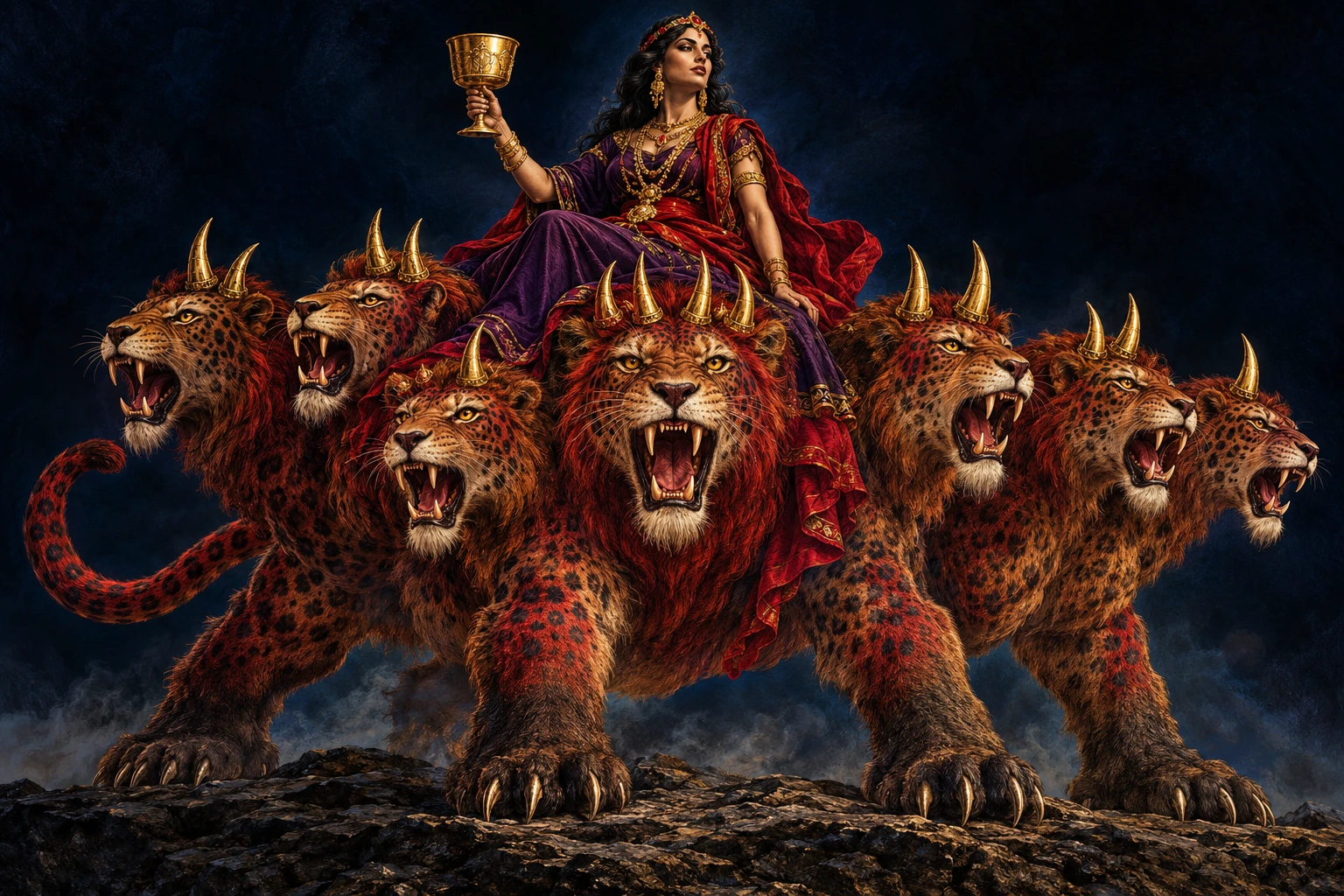
Artist’s illustration of Revelation 17’s woman and scarlet beast, incorporating animal imagery from Revelation 13 for comparison. The horns in the artwork are stylized; Scripture specifies seven heads and ten horns. The table supplies the precise descriptions. No present-day institution is identified by this artwork.
Read the features side by side
Daniel’s beast
What Daniel describes
What reappears in Revelation
LionDaniel 7:4
A lion with eagle’s wings; its wings are plucked. It stands like a man and receives a man’s heart.
Revelation 13:2 gives the sea beast a mouth like a lion’s. John does not repeat the eagle’s wings or the change of heart.Daniel 7:4; Revelation 13:2
BearDaniel 7:5
A bear raised on one side, with three ribs in its mouth, told to devour much flesh.
Revelation 13:2 gives the sea beast bear-like feet. John does not repeat the three ribs or its raised side.Daniel 7:5; Revelation 13:2
LeopardDaniel 7:6
A leopard with four wings and four heads, given dominion.
Revelation 13:2 describes the sea beast as leopard-like. Its seven heads differ from this leopard’s four; no four wings are specified.Daniel 7:6; Revelation 13:1–2
Fourth beastDaniel 7:7–8, 19–25
An unnamed, dreadful beast with iron teeth, brass nails and ten horns. A later horn speaks against God and makes war with the saints.
Daniel’s order is lion, bear, leopard, then the fourth beast. Revelation 13:2 names leopard, bear and lion when describing one beast. John combines the features that Daniel presents separately.
A common reading sees the later beast inheriting traits of earlier empires. The familiar Babylon → Medo-Persia → Greece → Rome identification is an interpretation of the kingdoms, not a list of names supplied in Daniel 7.
Seven heads and ten horns
Daniel’s leopard has four heads. Counting the other three beasts as one head each gives seven in total—a suggestive comparison with John’s seven-headed beast. Daniel does not explicitly give that total or say that John’s heads are those same kingdoms.
The ten-horn connection is more direct: Daniel 7:24 and Revelation 17:12 both interpret ten horns as ten kings. Their identity and sequence still require an argument.
Revelation 17’s scarlet beast has seven heads, ten horns and blasphemous names. Revelation 13’s sea beast also has seven heads, ten horns and blasphemy. These recurring details invite a connection.
She is clothed in purple and scarlet, adorned with gold, precious stones and pearls, and holds a golden cup. Her name is Babylon; she is associated with persecution, and the angel identifies her as a great city ruling over earthly kings.
The beast carries her. Later the horns and beast turn against her, desolate her and burn her. Her alliance with the beast does not make her the beast, the dragon or the second beast.
Does the proposed identification explain both their alliance and her destruction? What establishes continuity with Daniel’s fourth kingdom? How are Revelation’s seven kings and ten kings distinguished?
The dragon has seven heads and ten horns, but the text identifies him as the Devil and Satan. He gives the sea beast its power, throne and authority. The dragon and the beast must be distinguished.
This beast rises from the earth. It has two horns like a lamb but speaks like a dragon, promotes worship of the first beast and enforces its image and mark. The later false-prophet description recalls its signs and deception.
These belong to a separate vision. The angel identifies the ram with Media and Persia and the goat with Grecia. They should not be blended into Daniel 7’s four-beast description or treated as unnamed candidates.
Daniel’s vision does not end with the beasts. The Son of man receives an everlasting kingdom, and the saints possess the kingdom. Revelation likewise presents the Lamb overcoming hostile kings. The similarities should be read with that final victory in view.
Daniel 2 & 7 Fourth kingdomDaniel 8 Greek-successor hornRevelation 17 Beast + womanRevelation 18 Babylon’s fall
These labels mark separate study questions, not an assertion that all symbols identify the same figure.
Daniel 2 & 7
The fourth kingdom
What the text gives us
Daniel 2 names Nebuchadnezzar as the head of gold. Daniel 7 describes four beasts and interprets them as kingdoms. Identifying the fourth as Rome is a historical interpretation that must account for the sequence, strength, division, horns and final judgment.
A common Roman framework connects Babylon, Medo-Persia, Greece and Rome. Connecting the divided kingdom’s toes with Revelation’s ten horns is a further argument, not a verbatim identification in Daniel 2.
HARD QUESTIONS
Which features uniquely identify Rome? What establishes a future continuation or revival? Where does the text specify that the toes represent ten rulers?
Daniel 8
The horn and the daily sacrifice
What the text gives us
The chapter identifies the ram as Media and Persia and the goat as Grecia. The great horn is the first king, and four kingdoms arise afterward. The later king must be read within that explanation.
Antiochus IV is a prominent historical identification. A future fulfillment or foreshadowing requires an additional case. Moving directly to Rome, Muhammad or Islam must explain the Greek-successor setting.
HARD QUESTIONS
What connects the king to the four successor kingdoms? How do removal of the daily sacrifice, the 2,300 evenings and mornings, and sanctuary cleansing fit the proposed identification?
Revelation 17
The woman is not the beast
What the text gives us
The woman rides the beast. The angel describes seven mountains, kings, ten horns and a city reigning over the kings of the earth. The horns and beast ultimately turn against the woman.
Rome’s seven hills and imperial rule are relevant historical arguments. Identifying the woman specifically as the Vatican or a future religious institution requires evidence beyond identifying a Roman setting.
HARD QUESTIONS
How does the proposed city satisfy verse 18? Why do the horns destroy the woman? Which features establish a religious institution rather than imperial Rome, Jerusalem or another proposed city?
Revelation 18
Babylon’s merchants and maritime trade
What the text gives us
Kings, merchants and seafarers mourn Babylon’s fall. The passage describes wealth, luxury, cargo, human exploitation and persecution. Each identification must account for the full commercial picture.
Imperial Rome, a future commercial Babylon and Jerusalem are proposed readings. A city can influence trade without being a seaport, but influence alone does not prove this prophecy’s fulfillment.
HARD QUESTIONS
Which identification best accounts for the cargo, ships, worldwide trade, rule over kings and blood of the saints? Apply the same standard to Rome, Jerusalem and every alternative.
RELATED STUDY
Islam and the End Times
Trace the origins of the theory. Examine the kingdoms, the worship and the claims of identity.