They prophesy.
Two witnesses testify in sackcloth for 1,260 days. John describes two olive trees and two candlesticks, with power over rain, water and plagues.
Read verses 3–6 ↗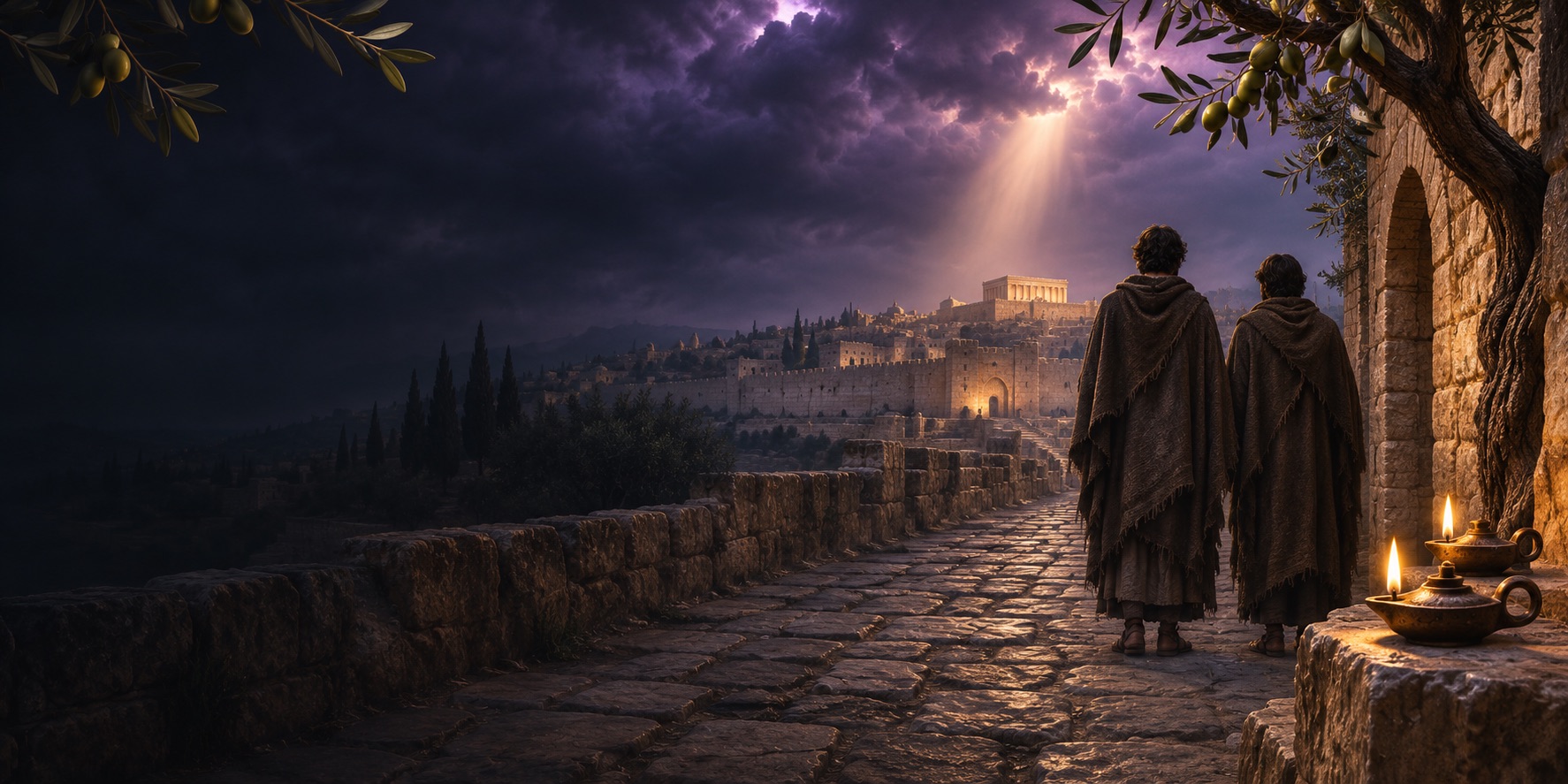
Revelation 11 · A study in testimony and vindication
When do they appear? Who are they? And how do their death and resurrection fit the seventh trumpet and the marriage supper?
Begin with the sequence John gives. Then examine the identities and timing connections Christians propose.
Revelation 11 does not name the witnesses. It describes their prophetic work, the beast’s attack, their public vindication and ascent. The following follows the narrative; it is not a calendar or a scale drawing.
Two witnesses testify in sackcloth for 1,260 days. John describes two olive trees and two candlesticks, with power over rain, water and plagues.
Read verses 3–6 ↗The attack succeeds when their testimony is finished. Their bodies are exposed for three and a half days in the city where the Lord was crucified.
Read verses 7–10 ↗After three and a half days they stand alive. A heavenly voice calls; they ascend in a cloud before their enemies. An earthquake follows in the same hour.
Read verses 11–13 ↗John marks the second woe as past before the seventh angel sounds. The announcement includes the kingdom, wrath, judgment and reward.
Read verses 14–18 ↗Keep two different intervals distinct: 1,260 days of prophecy; then three and a half days between death and rising. Their ascent is narrated before the seventh trumpet. Identifying that ascent with the church’s catching up is a further argument, not an identification supplied by John.
Their ministry lasts 1,260 days. Revelation 11 does not explicitly say they arrive on the first day or at the midpoint of Daniel’s final week. A future seven-year framework and the synchronization of its periods must be argued from the passages.
This proposal places their testimony early in the future week and their death near its midpoint. It must explain how their resurrection and ascent relate to the seventh trumpet later in the narrative, and why the beast’s attack belongs at that point.
This proposal connects their testimony with the period of the beast’s authority and pressure on the holy city. It must account for the full 1,260 days, the additional three and a half days, and the sequence leading to the trumpet.
These are timing proposals to examine, not exhaustive summaries or positions automatically held by everyone in a rapture camp. Equal or similar durations do not by themselves prove identical starting and ending points.
This site favours Enoch and Elijah as the two witnesses. The case begins with their extraordinary departures and the expectation of Elijah’s coming. Revelation 11 itself leaves their personal names unstated.
Enoch: Genesis says God took him; Hebrews explicitly says he was translated without seeing death. Elijah: 2 Kings describes his ascent in a whirlwind, and Malachi promises Elijah before the great and dreadful day of the Lord.
Supporters connect these departures with a future return, testimony and death. Hebrews 9:27 is part of that argument: if they have not died, might their appointed death still lie ahead? This is a proposed connection; none of these passages names Enoch as a witness in Revelation 11.
Elijah’s identification also requires care: Jesus relates Elijah language to John the Baptist, and Luke describes John in Elijah’s spirit and power. A future personal return should be defended alongside those explanations.
The witnesses’ powers recall Elijah’s drought and Moses’ signs involving blood and plagues. Moses and Elijah also appear together with Jesus at the transfiguration.
Those parallels make the proposal worth examining, but similarity of signs does not establish personal identity. Deuteronomy records Moses’ death. That fact challenges the argument that both witnesses must be men who have never died; whether that requirement is valid is the question addressed below.
Compare the signs, Moses’ death and the transfiguration · KJV ↗
A reading involving two future, otherwise unnamed prophets takes seriously their individual testimony, bodies, death and raising without importing names from another passage.
A symbolic reading draws attention to the olive trees and candlesticks. Zechariah 4 supplies the olive-tree imagery; Revelation 1 associates candlesticks with churches. Such a reading must explain why Revelation 11 describes two prophets and narrates their bodies and public resurrection so concretely. An individual reading must also account for the symbolism.
“And as it is appointed unto men once to die, but after this the judgment:”Hebrews 9:27 · KJV
This verse gives the Enoch-and-Elijah proposal an understandable question: if these men were taken without a recorded ordinary death, could they return to die as the witnesses? It reminds the reader of human mortality and accountability before God.
But it does not prove they must return. Read the next verse: the comparison concerns Christ’s once-offered sacrifice and His appearing again for salvation. The passage does not name the witnesses or prescribe how Enoch and Elijah must fulfil a future role.
Hebrews 11:5 expressly describes Enoch’s translation without seeing death. That statement should remain part of the argument, rather than being overwritten by an inferred universal requirement from Hebrews 9:27.
Read Hebrews 11:5 ↗Paul says not all will sleep, but all will be changed. His account of the catching up includes believers still alive. This prevents treating Hebrews 9:27 as an exceptionless rule that every individual must experience death before being with the Lord.
Read Paul’s explanation ↗The careful conclusion: Hebrews 9:27 matters to the discussion, but it cannot by itself establish the witnesses’ names or rule Moses out. Enoch and Elijah remain a defensible proposal to examine through the whole evidence, with the identity left less certain than the testimony, death and resurrection John actually describes.
Revelation 11 describes them ascending to heaven. Revelation 19 announces the Lamb’s marriage and blesses those called to His supper. It does not name the two witnesses among the guests, specify the meal’s duration, or explicitly say the supper is finished before the rider appears.
The seventh-trumpet case: in a consecutive reading, the witnesses are raised and taken up before the seventh trumpet. If the supper follows, their presence can be accommodated. That is a coherent possibility; it is not explicit proof of attendance or a unique advantage that automatically defeats other views.
Ask every model the same question: If the witnesses participate, does your proposed supper occur after they are raised and taken up? The answers below test possible sequences. A rapture label alone does not fix the witnesses’ ministry or the supper’s timing.
| Rapture view | How it can accommodate the witnesses | What it must explain |
|---|---|---|
| Pre-tribulation | The church’s earlier catching up need not mean the supper ends before the witnesses ascend. | A supper completed before their ascent would not accommodate their later bodily presence. Distinguish the rapture, marriage announcement and meal; establish the guest list. |
| Mid-tribulation | A supper after their ascent can accommodate them, whether the witness ministry is placed early or late. | Defend the ministry’s starting point and relate its full duration, death and ascent to the midpoint and trumpet. |
| Pre-wrath | Their ascent could precede a later supper even if it is distinct from the church’s earlier gathering. | Explain how the sixth seal, trumpets and witness narrative relate. Do not assume the witnesses must ascend with the church. |
| Post-tribulation | A supper associated with or following the return need not exclude witnesses already taken up. | Explain the relation between the heavenly marriage announcement, the gathering, the return and the meal; defend any proposed overlap. |
| Seventh trumpet | The narrated witness ascent precedes the trumpet; a later supper can include them. | Defend the identification of Paul’s last trump with John’s seventh, the broader chronology and the assumption that the witnesses attend. |
Compare Revelation 11 and 19 · KJV ↗
These are this study’s conditional comparisons of possible sequences, not quotations or universal statements about what every adherent teaches. Compatibility is not proof; an unestablished guest list is not evidence of exclusion.
Read the evidence · reviewed 28 October 2026
Scripture quotations use the King James Version. The identity, future-week synchronization and supper-participation arguments are interpretations, labelled accordingly. No present-day individual is identified as either witness.