The bride is gathered
Raised and changed; meeting the Lord in the air.
1 Corinthians 15:51–52; 1 Thessalonians 4:16–17Open the standalone marriage-feast study →
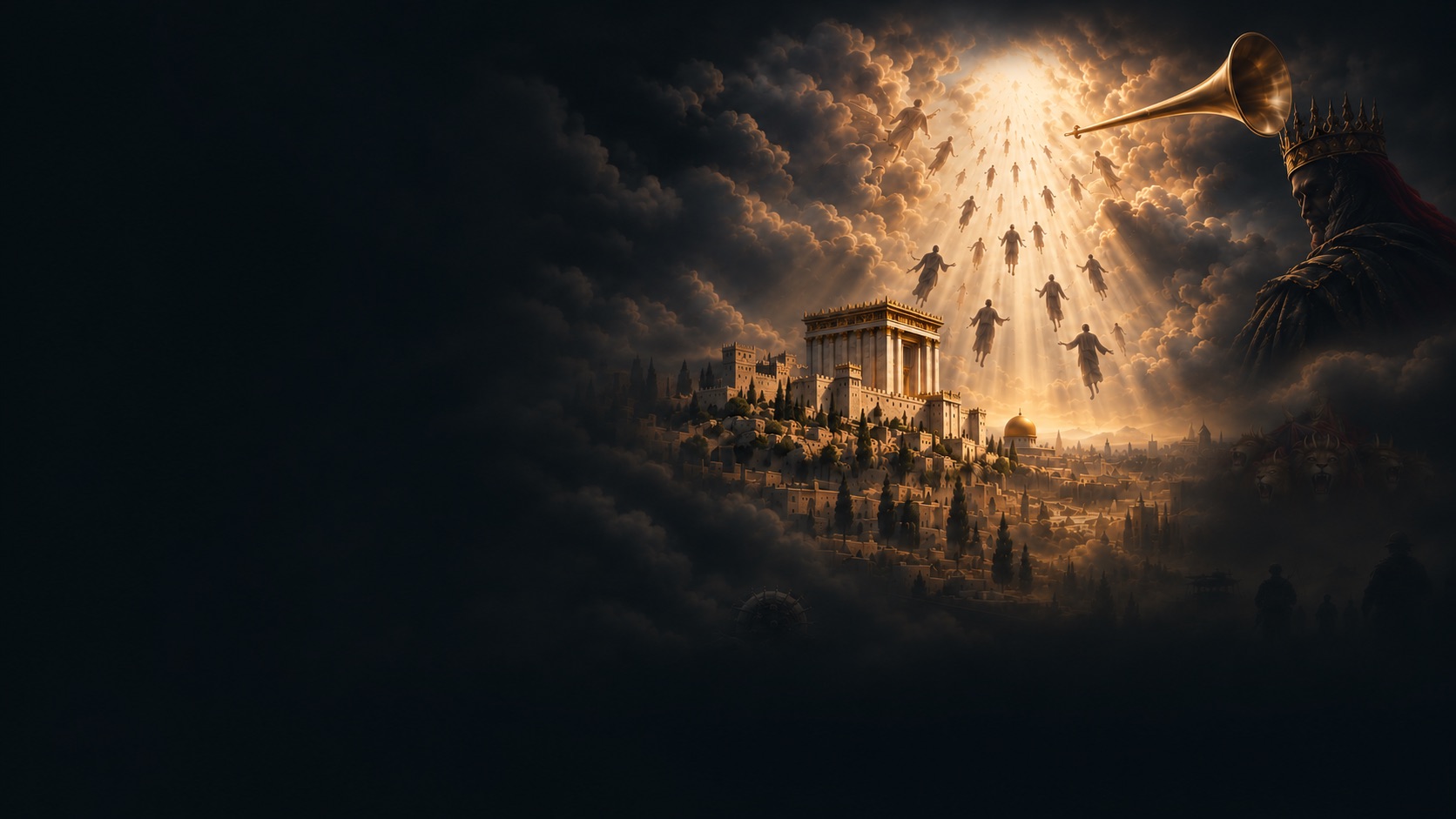
THE LAST TRUMP · THE RAPTURE · THE FINAL VIALS
This view places the gathering late in the final half, well after the midpoint, at the seventh trumpet and before the final outpouring of the vials. It connects Paul’s last trump with the kingdom, judgment and reward announced in Revelation 11.
The man of sin comes before the midpoint crisis. This site’s proposed chart places him at the beginning of the week, when it understands him to confirm the seven-year covenant. He may be recognizable even before that. The midpoint marks the stopping of sacrifice and the abomination, not necessarily his first appearance or recognition. Being recognizable, being revealed in Paul’s sense, and setting up the abomination need not all happen together. These connections are interpretations to test, not dates supplied by Paul. Read Daniel 9:27 and 2 Thessalonians 2:1–8.
Light: a reasonable explanation answers the difficulty. Medium: a substantial connection needs careful explanation. Heavy: the particular claim is difficult to reconcile with the cited text.
These are this site’s interpretive assessments of individual arguments, including the seventh-trumpet view. Read the objection and strongest supporting answer together. A dot grades a claim, and conditional grades name the version being tested. No dot means no assessment is shown here. An unmarked icon can open a topic study or a question already marked elsewhere.
Select an icon to explore its Scripture study. Questions and explanations appear below.
Chapter order, not a scaled timeline. The extent of overlap between visions is disputed; no additional dates are assigned here.
This site’s proposed reading places the rapture at the seventh trumpet, before the final vials. Identifying Paul’s last trump with John’s seventh trumpet remains an argument to establish, not an explicit cross-reference.
Revelation 11:18 already speaks of wrath; Revelation 15:1 calls the seven plagues the last, in which God’s wrath is filled up. “Before the vials” must not be treated as “before every mention of wrath.”
Read the passages · KJV ↗FUTURE SEVENTIETH WEEK · 7 PROPHETIC YEARS
2,520 days · Understand Daniel’s timetableCompare the same questions across all five views →
Open a question for the objection, the supporting answer and the passage. These are interpretation tests, not a score of anyone’s faith.
Light tension · this site’s assessment. The last-trump resurrection fits the seventh trumpet’s time of the dead and reward. The identification is a cumulative reading.
The case connects resurrection at Paul’s last trump with the gathering in 1 Thessalonians 4:16–17, the finished mystery in Revelation 10:7, and judgment and reward in 11:15–18. Identifying those trumpets is this site’s interpretation; no passage explicitly equates them.
The objection: Paul describes resurrection and transformation at the last trump, but does not number that trumpet as seven. Revelation 11 announces judgment and reward without narrating believers rising or being changed.
The case joins four connected passages: Paul’s resurrection and transformation at the last trump (1 Corinthians 15:51–52); the dead rising and the living gathered with the trump of God (1 Thessalonians 4:16–17); the mystery finished at the seventh angel (Revelation 10:7); and kingdom, the time of the dead, judgment and saints’ reward at the seventh trumpet (11:15–18). It then places the gathering before the final vials. The conclusion rests on this convergence, rather than on the word “last” alone.
Does Revelation 11:18 mark the actual occasion for these events, or announce a wider programme fulfilled in stages? Compare the resurrection, mystery, gathering and reward across the passages before deciding that the trumpets are identical or distinct. Earlier composition of Corinthians does not by itself disprove a shared prophetic event.
1 Corinthians 15:51–52; 1 Thessalonians 4:16–17; Revelation 10:7; 11:15–18 · KJV ↗Medium tension · this site’s assessment. The earlier wrath passages still need an explanation. The final vials are explicitly full of God’s wrath.
Earlier wrath is not an automatic contradiction of a pre-vial gathering, but it needs an explanation. Read Revelation 6:16–17, 11:18 and 15:1,7 together. Does the sequence involve an announcement followed by execution, protection during judgment, or overlapping visions?
The objection: Revelation 6:16–17 and 11:18 speak of wrath before the seven last plagues. Being gathered before the vials does not by itself establish deliverance before all divine wrath.
Supporters may distinguish announcements from the outpouring, understand visions as overlapping, or argue for protection during earlier judgments.
Which interpretation accounts for each earlier wrath passage and the promise of deliverance? The final vials complete wrath; that does not make every preceding judgment wrath-free.
Revelation 6:16–17; 11:18; 15:1,7; 16:1; 1 Thessalonians 5:9 · KJV ↗Light tension · this site’s assessment. The witnesses ascend before the trumpet in John’s account. A later supper can accommodate them and the bride before the battle.
A gathering before the battle allows time for marriage and heavenly presentation. Revelation 19 does not give the supper’s duration or name the witnesses as guests. Placing the whole supper during the vials also needs to account for Babylon’s judgment before the marriage announcement.
Revelation 11 narrates the witnesses’ ascent before the seventh trumpet. A later supper could include them, and Revelation 19 leaves their attendance and the length of the meal open. Babylon’s judgment precedes the marriage announcement in Revelation 19. Placing the supper during the vials needs a separate argument.
Read the two witnesses study →
The objection: Revelation 19 announces the marriage and blesses supper invitees before the rider appears, but does not explicitly state that the supper has finished. The witnesses are not named as guests.
Supporters connect the bride’s readiness and linen with the heavenly armies, placing the gathering and marriage before the battle-coming. A later supper can accommodate witnesses already taken up.
What establishes the meal’s timing, duration and participants? Distinguish the marriage announcement, the supper and the armies’ identity. The witnesses’ ascent before the seventh trumpet is not automatically the general rapture.
Revelation 11:11–15; 19:7–16; 1 Thessalonians 4:16–17 · KJV ↗Medium tension · this site’s assessment. The seventh trumpet announces judgment and reward. Which events happen at the sounding, and which unfold afterward?
Revelation 10:7 speaks of the days of the seventh angel; 11:15–18 announces judgment, reward and wrath. Identifying the trumpet still leaves a timing question: which events happen when it sounds, and which follow?
Paul places the resurrection and change at the last trump. If it is the seventh, the raising can occur at the sounding while other events announced there unfold later.
Show why the resurrection belongs at the sounding and how the gathering relates to the final vials. The witnesses’ ascent is a distinct event. If their 1,260 days start exactly at the midpoint, the additional 3½ days before they rise extend beyond a final half of exactly 1,260 days. Revelation 11 gives the duration and leaves their start within the week open.
1 Corinthians 15:51–52; Revelation 10:7; 11:15–18; 15:1–8 · KJV
360-day prophetic-year framework. Event spacing is schematic; the gathering arrows do not predict dates. Daniel 12’s 1,290 and 1,335 days are separate counts.
Daniel 9:27 describes a covenant with many for one week. Jesus describes deception, wars and famines as the beginning of sorrows; Matthew does not explicitly assign all of them to its first three and a half years.
Daniel 9:27; Matthew 24:4–8Daniel places the ending of sacrifice in the middle of the week. Jesus warns of the abomination of desolation. Paul describes the man of sin sitting in the temple of God and claiming to be God. This framework connects those passages with the midpoint crisis, not necessarily the first recognition or revealing of Antichrist. In this site’s reading, he confirms the covenant at the beginning of the seven years and may be recognizable before then. Connecting Daniel’s covenant-maker with Paul’s man of sin is an interpretation; Paul does not give his revealing a numbered point within the week.
Daniel 9:27; Matthew 24:15–16; 2 Thessalonians 2:3–4After the abomination warning, Jesus speaks of great tribulation and days shortened for the elect. Revelation describes the beast’s authority for forty-two months and war against the saints. Compare each view’s placement of the gathering and divine wrath.
Matthew 24:21–22; Revelation 13:5–7HEAVEN & EARTH IN THE SEVENTH-TRUMPET VIEW
Raised and changed; meeting the Lord in the air.
1 Corinthians 15:51–52; 1 Thessalonians 4:16–17The wife is ready, clothed in fine linen; the marriage supper is announced.
Revelation 19:1, 7–9This view places the gathered bride in heaven before the final outpouring.
Revelation 15:7; 16:1The King on a white horse; heavenly armies following in white linen. This view identifies the bride among those accompanying Him.
Revelation 19:11–16Sequence in this reading, not a measured calendar. The bride’s fine linen in verse 8 is compared with the heavenly armies’ linen in verse 14; identifying the bride among those armies is the connection drawn by this view.
SCRIPTURE CONNECTIONS · SELECT A MARKER TO EXPLORE
These markers open the supporting Scripture and explain how the events connect. The arrow is late in the final half; no exact day or year is assigned.
The midpoint is marked separately. The rapture arrow is deliberately much later. Its position is schematic and does not assign a specific year, day or duration to any interval.
THE SCRIPTURAL CASE
The objection: Paul describes resurrection and transformation at the last trump, but does not number that trumpet as seven. Revelation 11 announces judgment and reward without narrating believers rising or being changed.
The case joins four connected passages: Paul’s resurrection and transformation at the last trump (1 Corinthians 15:51–52); the dead rising and the living gathered with the trump of God (1 Thessalonians 4:16–17); the mystery finished at the seventh angel (Revelation 10:7); and kingdom, the time of the dead, judgment and saints’ reward at the seventh trumpet (11:15–18). It then places the gathering before the final vials. The conclusion rests on this convergence, rather than on the word “last” alone.
Does Revelation 11:18 mark the actual occasion for these events, or announce a wider programme fulfilled in stages? Compare the resurrection, mystery, gathering and reward across the passages before deciding that the trumpets are identical or distinct. Earlier composition of Corinthians does not by itself disprove a shared prophetic event.
1 Corinthians 15:51–52; 1 Thessalonians 4:16–17; Revelation 10:7; 11:15–18 · KJV ↗The objection: First Corinthians was written in the mid-50s AD, before the usual dating of Revelation in the AD 90s; Revelation’s date is debated. Paul’s explanation cannot assume that his readers already possessed John’s written sequence.
Supporters can argue that both writers describe the same future divine event, without claiming that Paul borrowed his wording from John’s later book.
Composition order does not disprove a shared event. The identification still needs support from Paul’s wording and the wider biblical trumpet imagery, rather than an assumed literary dependence.
1 Corinthians 15:51–52; Numbers 10:1–10; Matthew 24:31 · KJV ↗The objection: The seventh trumpet appears in Revelation 11, while chapters 12–14 describe the woman, dragon, beast, mark and forty-two months. A simple chapter-by-chapter chronology would place those scenes after the trumpet.
Supporters read these visions as revisiting or expanding earlier events, rather than beginning every event at the point John narrates it.
Which narrative markers establish the proposed overlap? The chart needs a reasoned chronology; it cannot rely on chapter order for the vials while assuming earlier beast events without explanation.
Revelation 11:15–19; 12:1–6; 13:1–18; 14:1–20; 15:1 · KJV ↗The objection: Revelation 6:16–17 and 11:18 speak of wrath before the seven last plagues. Being gathered before the vials does not by itself establish deliverance before all divine wrath.
Supporters may distinguish announcements from the outpouring, understand visions as overlapping, or argue for protection during earlier judgments.
Which interpretation accounts for each earlier wrath passage and the promise of deliverance? The final vials complete wrath; that does not make every preceding judgment wrath-free.
Revelation 6:16–17; 11:18; 15:1,7; 16:1; 1 Thessalonians 5:9 · KJV ↗The objection: Revelation 19 announces the marriage and blesses supper invitees before the rider appears, but does not explicitly state that the supper has finished. The witnesses are not named as guests.
Supporters connect the bride’s readiness and linen with the heavenly armies, placing the gathering and marriage before the battle-coming. A later supper can accommodate witnesses already taken up.
What establishes the meal’s timing, duration and participants? Distinguish the marriage announcement, the supper and the armies’ identity. The witnesses’ ascent before the seventh trumpet is not automatically the general rapture.
Revelation 11:11–15; 19:7–16; 1 Thessalonians 4:16–17 · KJV ↗The objection: The chart puts the gathering late in the final half, but the seventh-trumpet identification does not supply a numbered day or authorize a return-date calculation.
Supporters distinguish an expected order of events from knowing their calendar dates. The arrow expresses the proposed sequence.
Do the passages establish the relative position shown, and does any proposed calculation depend on an assumed starting date? Watchfulness remains the practical conclusion.
Matthew 24:32–44; Revelation 10:7; 11:15–18 · KJV ↗THE CLOUDS · THE BRIDE · THE KING
Acts 1:9–11 describes Jesus being taken up, a cloud receiving Him from sight, and two men in white apparel promising that this same Jesus will come in like manner.
Acts 1:9–11Paul describes the Lord descending with a shout, the archangel’s voice and God’s trumpet. The dead rise, and believers meet Him in the clouds. This passage does not describe a white horse or the rider’s battle attire.
1 Thessalonians 4:16–17; Matthew 24:30–31Revelation 19 describes a white horse, eyes like flame, many crowns, a blood-dipped vesture, the Word of God and the heavenly armies following Him. His purpose here is judgment and war.
Revelation 19:11–16The argument distinguishes gathering the bride to Christ from Christ returning with His bride after the heavenly marriage scene. A model that combines the gathering and battle-coming must explain where the marriage supper fits and why the accompanying armies are already in heaven.
Acts 1 promises the return of the same Jesus in like manner; it does not explicitly require identical clothes or appearance. The different descriptions therefore contribute to the sequence argument, but appearance alone does not prove two events. The marriage scene, the direction of the gathering and the accompanying saints must be considered together.
Acts 1:9–11; 1 Thessalonians 4:16–17; Revelation 19:7–16THE SCROLL · THE ALARM · THE WRATH
The images do different work. The Lamb opens the sealed book. Trumpets sound the alarm and announce judgments. The final vials are poured out, full of God’s wrath.
Revelation 5 describes one book sealed with seven seals—often pictured as a scroll. Only the Lamb is worthy to open it. The seal scenes unfold in chapters 6–8; the seventh seal is followed by the seven angels receiving trumpets.
Revelation 5:1–9; 6:1; 8:1–6Trumpets called assemblies, directed movement and sounded a battle alarm in Israel. Joel uses the trumpet to warn that the day of the LORD is near. Revelation’s trumpets carry that alarm imagery, but also bring destructive judgments.
Numbers 10:1–10; Joel 2:1; Revelation 8:6–13The KJB calls them “vials.” Revelation 15:7 explicitly says they are full of God’s wrath; chapter 16 commands their pouring out. These are the seven last plagues, in which His wrath is brought to completion.
Revelation 15:1, 7; 16:1, 17This follows the order in which John presents the scenes. Whether the series are entirely consecutive, overlap, or revisit events must be tested separately.
WHY CALL THEM WARNING TRUMPETS?
A trumpet carries an audible public signal: gather, move, prepare for battle, or take warning. Numbers 10 distinguishes the gathering signal from the alarm. Ezekiel’s watchman blows the trumpet when danger comes; the hearer is responsible to heed it.
Numbers 10:2–9; Ezekiel 33:2–6; Joel 2:1Revelation 9:20–21 says that survivors still did not repent. That supports reading the trumpet judgments as warnings calling for repentance. “Warning trumpets” is an explanatory description, not John’s formal title—and the warning includes real suffering and death.
Revelation 9:20–21THE JERICHO CONNECTION
At Jericho the priests blew trumpets during the marches. On the seventh circuit of the seventh day, the trumpet sounded, the people shouted, and the wall fell. Rahab and her household were spared.
Joshua 6:4–5, 13–17, 20–25The pattern invites comparison: seven trumpets, God’s victory, judgment and deliverance. It is a biblical parallel to examine; Joshua does not explicitly identify Jericho’s final blast with Paul’s last trump or date Revelation’s gathering.
Revelation 11:15–18 announces Christ’s kingdom, God’s wrath, judgment of the dead and reward of His servants. Paul places resurrection and transformation at the last trump. Their relationship deserves its own chart and examination.
Revelation 11:15–18; 1 Corinthians 15:51–52Calling the bowls the final outpouring does not make every earlier judgment wrath-free: Revelation 6:16–17 and 11:18 already speak of wrath. Those earlier announcements should be read alongside the final outpouring described in chapters 15–16.
Revelation 6:16–17; 11:18Examine the seventh trumpetA sequence every view must examine
John narrates the witnesses’ ascent before the seventh angel sounds. A later supper can accommodate them; their attendance and the identity of the last and seventh trumpets still require argument.
Examine their ministry, identity and resurrection →The composition dates provide context, not a verdict on whether the passages concern the same event.
ESV introduction · dating 1 Corinthians ↗ · Daniel B. Wallace · the date of Revelation and competing proposals ↗
THE INVITATION · THE BRIDE · THE RETURN
The clearest narrative sequence: Revelation 19:7–8 announces the marriage and the wife’s readiness; verse 9 blesses those called to the supper; verses 11–14 show Christ and the heavenly armies coming for battle; verses 19–21 describe the defeat and slaughter of the opposing forces. This is evidence for the marriage before the battle. Verse 9 does not explicitly state that the supper has already finished.
The argument for a later supper: Matthew 26:29 and Luke 22:18,29–30 promise future eating and drinking with Christ in His kingdom. Connecting that kingdom meal with the marriage supper and placing it after the victorious return are additional interpretive steps. These passages do not name the marriage supper or expressly put it after the slaughter.
Study conclusion: The marriage is announced before the battle; placing the marriage supper after it requires an additional interpretive argument. A distinction between marriage and supper should be examined, not assumed. Keep the Lamb’s supper in verse 9 distinct from the birds’ judgment supper in verses 17–18.
Revelation 19:7–21 · KJV ↗ · Matthew 26:29; Luke 22:18,29–30 · KJV ↗
Revelation 19:7–9 announces the Lamb’s marriage, the readiness of His wife, and the blessing of those called to the marriage supper. This heavenly scene is central to this site’s argument that Christ’s people are with Him before His battle-coming.
In Matthew 22:1–14, those first invited will not come; others are then called from the highways. The wedding garment also matters. In Luke 14:16–24, invited guests make excuses, the invitation is extended to others, and the refusing guests are excluded from the supper. These passages warn against rejecting God’s invitation; they do not give a numbered timetable.
Matthew 22:1–14; Luke 14:16–24 · KJV ↗Revelation 19 announces the marriage and supper before the vision of the rider coming for battle. The wife is clothed in fine linen, and the heavenly armies also wear fine linen. This site connects these scenes with the bride’s presence with Christ before His return; identifying every member of the armies and the precise duration of the feast requires interpretation.
Revelation 19:1–14 · KJV ↗And the 144,000? Revelation 7:4–8 numbers the sealed servants from Israel’s tribes. Revelation 14:1–5 shows 144,000 with the Lamb, redeemed from the earth and described as firstfruits unto God and the Lamb. Where do they fit in the marriage and supper? Those passages do not expressly assign their place at the feast or exclude them. Their participation is an open question; pre-tribulation teachers do not all exclude them from the supper.
The site’s interpretation: the marriage feast represents those who receive the invitation, while those who reject it remain outside. Connecting the excluded guests with everyone remaining on earth at a particular point in Revelation is a further conclusion drawn by comparing passages; neither parable explicitly supplies that worldwide identification or its timing.
Revelation 19:9 describes the blessed guests called to the Lamb’s supper. Revelation 19:17–18 describes a different supper: birds summoned to the aftermath of judgment. Keep those two invitations distinct.
Revelation 19:9,17–18 · KJV ↗