Daniel 9:27; Matthew 24:15; 2 Thessalonians 2:3–4
What the text says
Begin with the passages.
Daniel speaks of sacrifice and offering being stopped. Jesus refers to the abomination of desolation standing in the holy place. Paul describes the man of sin sitting in the temple of God. Read each in its own context.
Read the full context ↗What requires interpretation
Examine the connection.
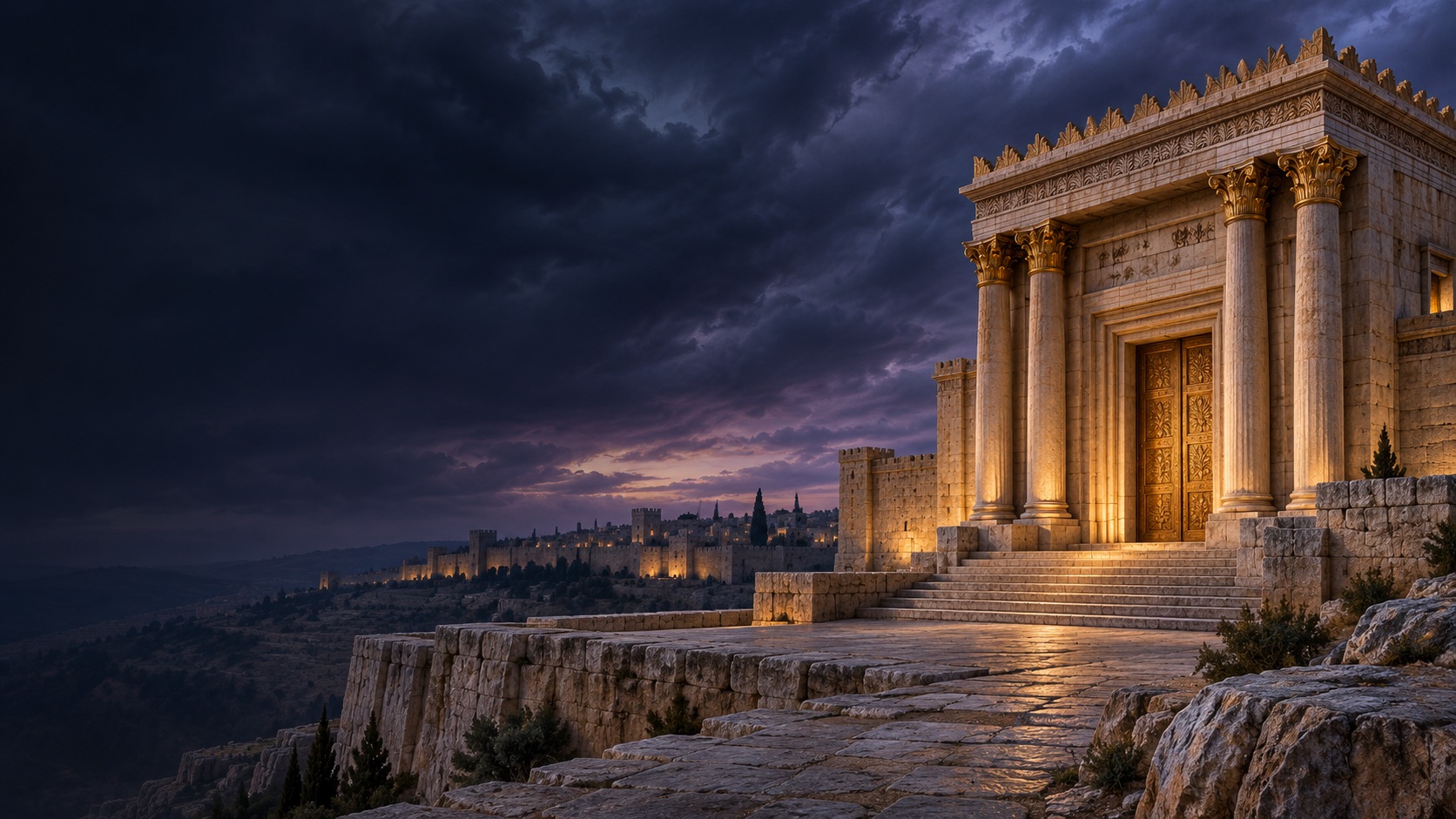
“Third temple” is a label used in a future-temple interpretation; these passages do not number a future building as the third temple or supply a construction date. Historical, future and symbolic readings require examination. The illustration is an imagined temple, not an architectural prediction.
The challenge
What must your reading answer?
Why does your interpretation require a future building? How do you account for the historical temple and the wording of each passage?
Read more closely
Why a future temple is discussed
A future-temple argument brings together the ending of sacrifice and offering in Daniel, the abomination in the holy place in Matthew, and the man of sin in the temple of God in Paul. Taken within a future-crisis reading, these passages are understood to require a renewed temple setting.
That is a connected argument. The passages do not call a future building “the third temple”, announce its construction date or supply a modern architectural plan. The label identifies a common interpretation, not a phrase these verses use.
Read Daniel 9:27; Matthew 24:15; 2 Thessalonians 2:3–4 · KJV ↗
The historical setting cannot be skipped
The discourse begins with Jesus and the disciples discussing the temple buildings and their destruction. Luke also records Jerusalem surrounded by armies and its desolation. Historical Jerusalem and its sanctuary are part of the context readers must address.
Interpreters differ on how much of the discourse concerns the first-century destruction and how much concerns a future culmination. Some understand a historical event as a pattern pointing beyond itself. Those distinctions should be explained, not hidden under a picture of a future building.
What does “temple of God” mean here?
The future-building reading takes Paul’s temple language in 2 Thessalonians as a sanctuary in which the final opponent exalts himself. Other readings appeal to Paul’s use of temple language for God’s people. That usage creates a question, not an automatic answer for every occurrence.
Test the local context, the described action and the relationship to Daniel. A symbolic use elsewhere does not prove a symbolic meaning here; a historical sanctuary elsewhere does not independently prove a future reconstruction here.
Read 2 Thessalonians 2:4; 1 Corinthians 3:16–17; Ephesians 2:19–22 · KJV ↗
What to ask about a modern claim
A report about temple advocacy, ritual preparation or a building proposal is not the same thing as the fulfillment of every temple-related passage. A claim needs verifiable facts as well as an explanation of which verse is being fulfilled and why.
This site sets no construction date or rapture date. The illustrated temple is symbolic artwork. Its appearance is not evidence of what any future building would look like.