Revelation 17:1–18; 18:1–24
What the text says
Begin with the passages.
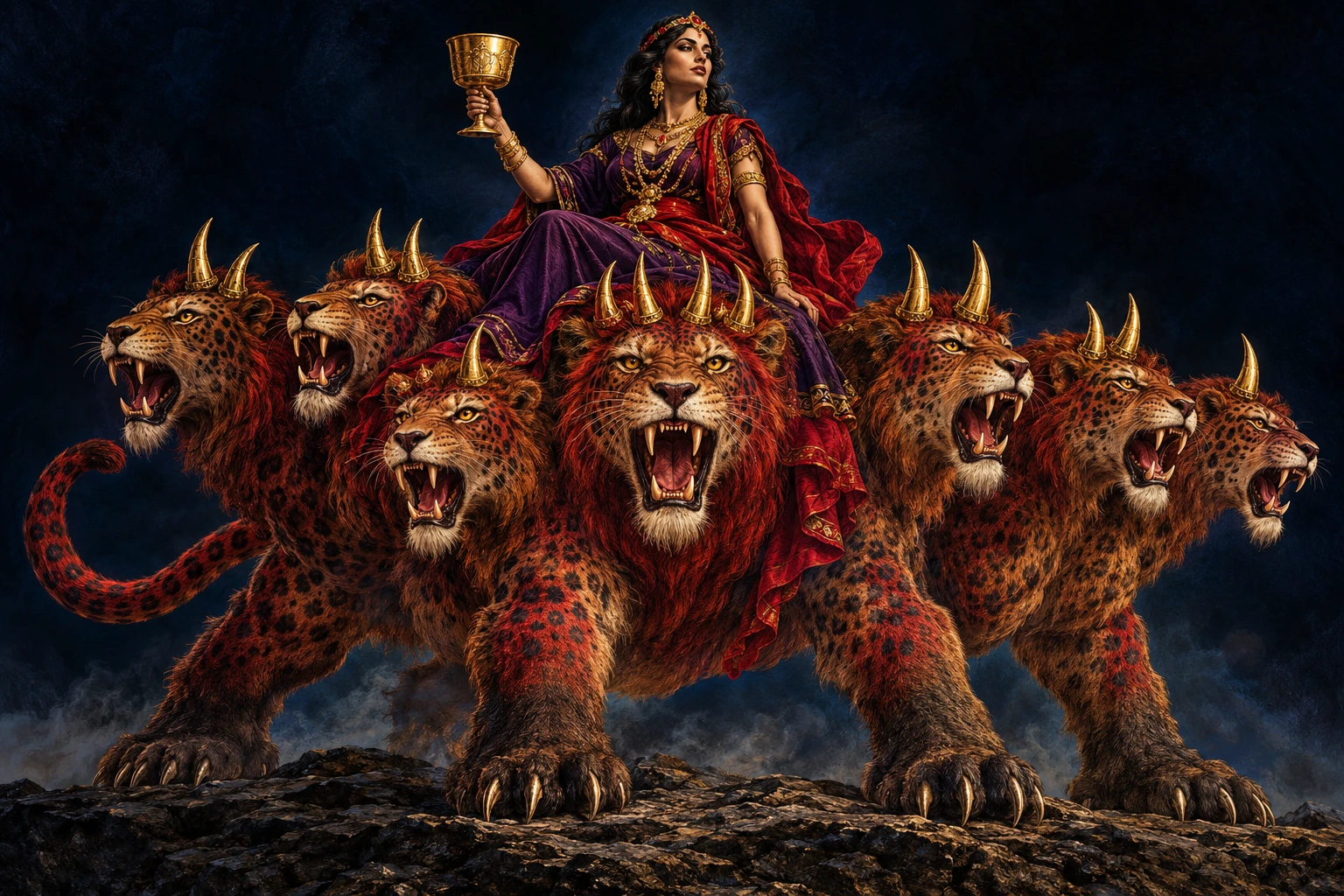
Revelation 17 depicts a woman sitting on a scarlet beast, with the name Babylon the Great. The angel explains waters as peoples, multitudes, nations and tongues, and describes the woman as a great city reigning over the kings of the earth. The ten horns eventually turn against her.
Read the full context ↗What requires interpretation
Examine the connection.
The woman and the beast are related but distinct in the vision. Historical and future identifications of Babylon need evidence; a symbol is not established by pointing to a modern group. Revelation 18 adds commerce, wealth, judgment and lament to the picture.
The challenge
What must your reading answer?
Does your proposed identity account for the city, kings, trade, persecution and the beast’s eventual hostility to the woman? Read the angel’s explanation before importing a theory.
Read more closely
Begin with the angel’s explanation
John sees a woman seated on a scarlet beast. She is dressed in purple and scarlet, adorned with gold, precious stones and pearls, and holds a golden cup. Her name is Babylon the Great. The vision also describes her as drunk with the blood of the saints and martyrs of Jesus.
The angel explains the waters as peoples, multitudes, nations and tongues, and the woman as a great city reigning over the kings of the earth. These explanations constrain an interpretation. Clothing or wealth alone cannot establish an identity.
The woman and beast are not the same symbol
The beast has seven heads and ten horns. The explanation relates the heads to mountains and kings and the horns to kings who receive power with the beast. The chapter describes their opposition to the Lamb and the Lamb’s victory.
The ten horns eventually hate the woman and bring about her destruction. An interpretation must explain that change in relationship. A theory that treats the woman and beast as one undifferentiated power misses an important feature of the vision.
Revelation 18 adds the economic dimension
Kings, merchants and seafarers lament Babylon’s fall. The chapter lists luxurious goods and includes slaves and souls of men in its account of commerce. It also describes deception and responsibility for bloodshed.
This broadens the question beyond a single religious emblem. A proposed identity should account for political influence, commerce, luxury, deception, persecution and judgment together. The chapter’s detail should be allowed to challenge an attractive but incomplete identification.
Compare identifications without pretending certainty
Interpretations have identified Babylon with imperial Rome, a later religious-political system, a future city, or a wider pattern of corrupt power. These are alternatives to examine; naming one is not proof that it accounts for every feature.
The illustration is symbolic and assigns no identity to a living individual or present-day community. Begin with the vision and the angel’s explanations, then compare a proposal’s strongest evidence with the details it finds hardest to explain.